

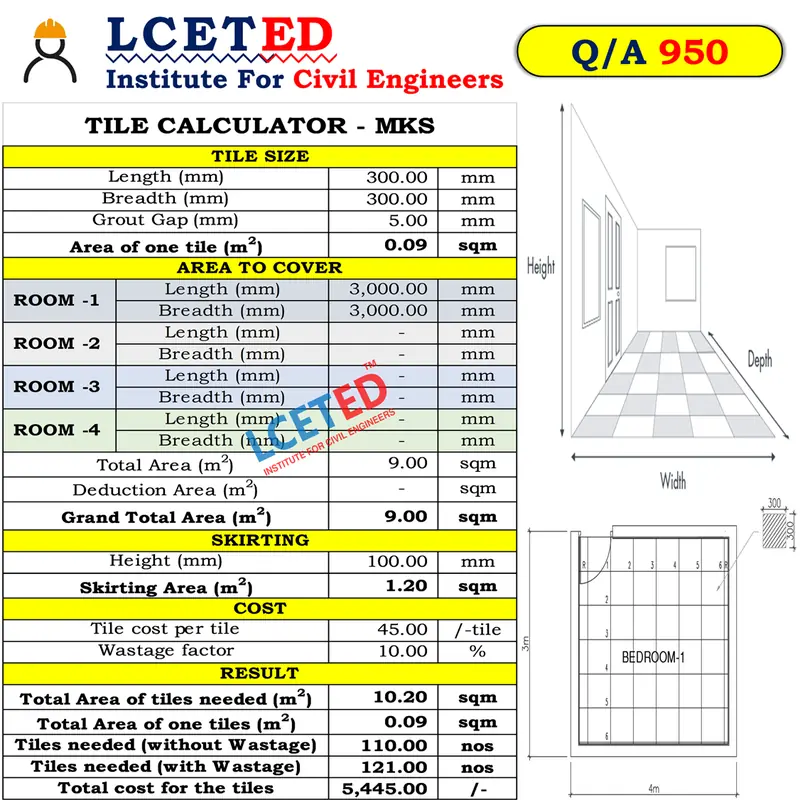
The construction and home renovation industry is currently undergoing a digital transformation driven by the need for extreme fiscal precision and material efficiency. As raw material costs fluctuate globally, the margin for error in floor and wall installations has tightened, leading professionals to rely on advanced digital tools. Central to this movement is the tile calculator 600×600, a specialized software solution designed to handle the industry-standard 600mm x 600mm format. This specific dimension has become the benchmark for modern residential and commercial flooring, and the software surrounding its estimation is now more sophisticated than ever, integrating grout gap analysis, waste percentages, and even regional cost breakdowns.
Industry analysts report that the shift toward these digital estimators is not merely a convenience but a financial necessity. By utilizing a high-precision tile calculator, project managers can account for the intricate variables of a room’s layout, including the often-overlooked overlap or gap between tiles. This ensures that procurement orders are exact, preventing the costly “over-ordering” that has plagued the industry for decades. In an era where supply chain disruptions remain a concern, knowing exactly how many units are required to cover a surface area is the difference between a project finishing on schedule or stalling due to a shortage of matching dye lots.
Related News: Global Trends in Sustainable Building Materials for 2025
The Mathematical Precision of the 600×600 Format
The 600x600mm tile is favored for its aesthetic versatility and the perception of space it creates in smaller rooms. However, its large format makes manual calculation deceptively complex. Unlike smaller mosaics, where a few extra pieces are negligible, the sheer surface area of a 600x600mm slab means that a miscalculation of even a few inches can result in an entire box of wasted material. This is where the tile calculator 600×600 proves its worth, translating total square footage into the exact number of physical units required while factoring in the geometry of the space.
Modern tools, such as those provided by Orientbell Tiles, have evolved to offer more than just a raw count. These systems now calculate the specific number of boxes required based on the manufacturer’s packaging standards. This level of granularity allows contractors to present transparent bids to clients, showing the direct correlation between the floor area and the purchasing requirements. This transparency is vital for maintaining trust in high-stakes commercial contracts where every dollar is scrutinized.
Advanced Features in Contemporary Estimation Tools
Recent updates to calculation platforms have introduced variables that were previously left to “rules of thumb.” For instance, the inclusion of a “waste allowance” is now a standard feature in digital suites. Experts suggest a 10% waste buffer for standard layouts and up to 15% for diagonal patterns. A professional tile calculator 600×600 will automatically suggest these buffers based on the user’s input. Platforms like Tools4Free provide these services without the need for complex sign-ups, allowing for instant grout and tile count estimations on the fly.
Beyond the tiles themselves, the calculation of consumables such as grout and adhesive has become a integrated part of the workflow. The volume of grout required is heavily dependent on the depth of the tile and the width of the gap—variables that are often miscalculated by hand. By using a tile calculator 600×600 that features grout estimation, installers can ensure they have enough binding material to finish the job in one continuous session, which is critical for color consistency across the floor.
Related News: Smart Home Tech Integrations for New Floor Installations
Economic Impact and Regional Cost Breakdowns
The economic implications of these tools are being felt on a global scale. In emerging markets, such as Kenya, the integration of pricing data directly into the calculation workflow is a game-changer. The TopCalculator 2025 update specifically includes Kenyan tile prices and cost breakdowns for adhesive and grout. This localized data allows small-scale builders to compete with larger firms by providing highly accurate, localized quotes that reflect current market conditions.
Furthermore, the ability to estimate total project costs instantly empowers homeowners to make informed decisions before a single cent is spent. By entering their area dimensions into a tile calculator 600×600, users can visualize the financial impact of choosing different materials or layouts. This democratization of data is shifting the power dynamic in the renovation market, moving it away from “estimates” and toward “guaranteed quotes.”
Standard Features of Modern Tile Calculators
To understand the depth of these tools, one must look at the data points they now process. The following table illustrates the capabilities of the current generation of digital estimators compared to traditional manual methods.
| Feature | Manual Calculation | Digital Tile Calculator |
|---|---|---|
| Unit Count | Approximation | Exact count based on mm/inch |
| Waste Allowance | Guesswork (usually 10%) | Adjustable (10-20% based on pattern) |
| Grout Volume | Rarely calculated | Precise liters or kg based on gap width |
| Box Conversion | Manual division | Automatic based on box sq. units |
| Cost Estimation | Separate calculation | Real-time integration |
Specialized Applications: The Bathroom and High-Moisture Zones
When it comes to specialized areas like bathrooms, the tile calculator 600×600 must account for unique obstacles such as vanities, drains, and shower niches. Leading design firms like Mercury Mosaics emphasize that while the math is simple, the application in complex spaces requires a systematic approach. Their guides highlight the importance of breaking the room down into sections—floors, accent walls, and wet zones—before running the final calculation.
The 600x600mm format is particularly popular in bathroom renovations because it minimizes grout lines, which are often the first points of failure in high-moisture environments. However, these large tiles require a perfectly level substrate. Digital calculators help identify the amount of thin-set or self-leveling compound needed, which is a secondary but vital step in ensuring a long-lasting installation.
Related News: How Global Supply Chains are Affecting Tile Prices in 2025
Technical Breakdown: The Math Behind the 600×600 Algorithm
For those interested in the underlying mechanics, the tile calculator 600×600 operates on a specific geometric algorithm. Each 600x600mm tile covers exactly 0.36 square meters. However, the calculation is not as simple as dividing the total area by 0.36. The software must account for the “edge cut.” When a tile reaches a wall, any portion that is cut off and cannot be used elsewhere in the layout is effectively wasted. Advanced algorithms simulate the placement of tiles across the surface to determine how many full tiles and how many partial tiles are needed, providing a far more accurate figure than simple area division.
Furthermore, the “gap” factor is essential for large-format tiles. A 3mm grout gap might seem insignificant, but over a 100-square-meter floor, those gaps can add up to the equivalent of several tiles. The tile calculator 600×600 adjusts the effective area of each tile to 603mm x 603mm (for example), ensuring that the buyer does not over-purchase due to the space taken up by grout.
Eliminating the “Dye Lot” Risk
One of the most critical risks in tile installation is running out of material mid-project. Tiles are manufactured in batches, and “dye lots” can vary significantly in shade or texture between production runs. If a contractor under-orders because they didn’t use a tile calculator 600×600, they may find that the replacement tiles do not perfectly match the existing floor. By using a precise digital tool at the outset, the entire requirement—including waste—can be purchased from a single dye lot, ensuring a seamless aesthetic finish.
This risk management is why major retailers and manufacturers are now embedding these calculators directly into their e-commerce platforms. It reduces the rate of returns and increases customer satisfaction by ensuring the job is done right the first time. The trend is clear: the future of home renovation is data-driven, and the humble tile calculator is at the forefront of this revolution.
Best Practices for Using a Digital Estimator
To maximize the utility of these tools, industry experts recommend several best practices. First, measurements should be taken at multiple points in a room to account for walls that may not be perfectly square. Second, always choose the specific tile size—in this case, ensuring the tile calculator 600×600 setting is selected—rather than using a generic “large format” option. Finally, users should always account for baseboards and trim, which may slightly reduce the actual floor area but increase the complexity of the cuts required.
As the construction sector continues to grapple with labor shortages and material costs, the efficiency provided by these digital tools becomes an invaluable asset. Whether for a DIY bathroom refresh or a massive commercial lobby, the precision of a digital estimate is no longer optional—it is the industry standard.